
 See My Latest Article on HelloNation
What is the basic difference between made-to-measure and bespoke tailoring?
Made-to-measure clothing adjusts an existing pattern to fit an individual wearer. Bespoke tailoring creates a garment pattern specifically for that person, usually through more extensive measurements, fittings, and design decisions.
Both methods can produce high-quality men’s clothing, but they differ in how the pattern is developed, how much control the wearer has over the design, how many fittings are involved, and how the finished garment is refined.
For residents choosing formalwear, business clothing, or a long-term wardrobe investment, the distinction is less about which option is automatically “better” and more about which process suits the desired fit, timeline, budget, and level of customization.
How does made-to-measure work?
Made-to-measure begins with a pre-existing base pattern. Measurements are taken and adjustments are made to areas such as jacket length, sleeve length, shoulder width, chest, waist, trouser rise, and leg opening.
The garment is then produced using those modified specifications. Depending on the tailor and garment, there may be one fitting before completion and sometimes a final adjustment afterward.
Made-to-measure is often suitable for someone whose proportions differ from standard sizing but do not require a completely new pattern. For example, a man with a broad chest and a relatively narrow waist may obtain a more balanced fit through adjustments than he would from an off-the-rack suit.
Typical made-to-measure choices may include:
- Fabric
- Jacket and trouser measurements
- Lapel width and style
- Number of buttons
- Pocket design
- Trouser cuffs
- Lining color
- Thread and button details
The available options vary. Some programs offer extensive customization, while others are closer to an altered ready-to-wear garment.
What makes bespoke tailoring different?
Bespoke tailoring generally involves drafting a new pattern for the individual rather than modifying a standard pattern. The tailor studies the wearer’s posture, balance, shoulder slope, stance, and body proportions in greater detail.
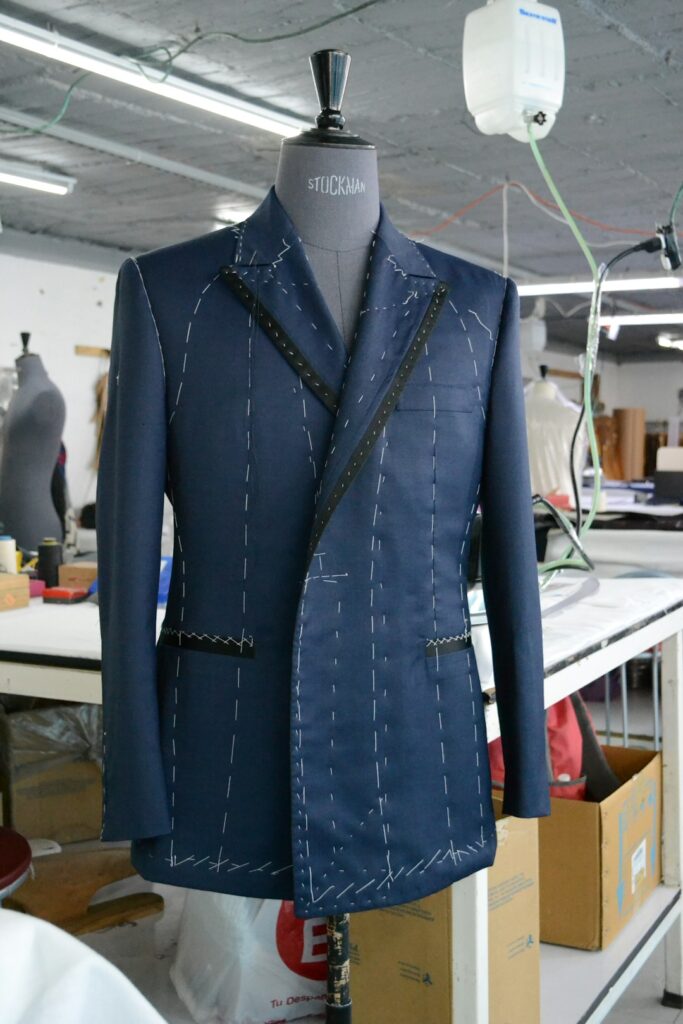
A first fitting is usually made with temporary or loosely assembled fabric. This allows the pattern to be evaluated before the final garment is constructed. Additional fittings may follow as the shape is refined.
The bespoke process can address details that are difficult to correct through ordinary alterations, including:
- Uneven shoulders
- A forward or erect posture
- Differences in hip height
- A prominent or hollow chest
- A sloping back
- An unusual sleeve angle
- A preference for a particular jacket balance
Bespoke clothing also tends to involve more decisions about structure and construction. The wearer may have greater influence over the canvas, stitching, pockets, lapel roll, button stance, vents, trouser construction, and overall silhouette.
The key distinction is that bespoke tailoring is built around a new pattern and an iterative fitting process. Made-to-measure is built around adapting an existing pattern.
Is bespoke always a better fit?
No. A properly executed made-to-measure garment can fit very well, while an inexperienced or rushed bespoke process may not meet expectations. The skill of the cutter, accuracy of measurements, quality of communication, and number of meaningful fittings all affect the result.
Bespoke offers more opportunity to correct complex posture and proportion issues, but that opportunity depends on the process being handled carefully. A new pattern alone does not guarantee a superior garment.
Made-to-measure may be the more practical choice for a man whose body is relatively symmetrical and whose main needs involve adjusting standard dimensions. It can provide a substantial improvement over ready-to-wear sizing without requiring the time and expense associated with a fully individualized pattern.
Which option is more practical for Buffalo residents?
Climate and daily use can influence the decision. Buffalo has cold winters, shifting spring and fall temperatures, and humid summer conditions. A wardrobe may need to work across indoor heating, outdoor cold, wind, rain, and seasonal changes.
For that reason, fabric and construction deserve as much attention as the label attached to the tailoring method. A made-to-measure suit in a well-chosen seasonal cloth may be more useful than a bespoke suit made from a fabric that is too heavy, too delicate, or difficult to maintain.
Practical considerations include:
- A breathable wool or wool blend for extended indoor wear
- A moderately structured jacket for professional settings
- Layering room for colder months
- Durable trouser fabric for frequent use
- Water-resistant outerwear when commuting or walking outdoors
- Lining and sleeve choices that do not create excessive warmth indoors
A garment should also fit the wearer’s actual routine. Someone who wears tailoring several times a week may benefit from more detailed customization. Someone who needs one dependable suit for occasional events may find made-to-measure sufficient.
How much time does each process usually require?

Made-to-measure generally follows a shorter and more predictable schedule because the base pattern already exists. The time required depends on the maker, fabric availability, production location, and alteration needs.
Bespoke tailoring usually takes longer because the pattern is drafted, tested, adjusted, and then used for the final garment. Several fittings may be needed, particularly when the wearer has unusual posture or wants a highly specific silhouette.
The most useful question is not simply, “How fast can it be finished?” It is, “How much fitting time is built into the process?” A quick process with limited opportunity for correction may be less useful than a slower process with clear checkpoints.
Seasonal planning also matters. Formal events, weddings, professional changes, and holiday gatherings can create crowded production schedules. Allowing time for fittings and final alterations reduces pressure.
Is bespoke tailoring worth the additional cost?
Bespoke usually costs more because it requires more individual labor, pattern development, fittings, and hand-finishing. Whether that cost is worthwhile depends on how often the garment will be worn and how difficult the fit is to achieve through other methods.
Bespoke may make sense when:
- Standard proportions consistently fit poorly
- The garment will be worn frequently for many years
- The wearer has strong preferences about silhouette and construction
- Posture or asymmetry requires detailed correction
- The fitting process itself is a valued part of the experience
Made-to-measure may provide better value when the primary goal is improved fit, fabric choice, and styling flexibility without a highly involved construction process.
Cost should also include future maintenance. A well-fitting garment still needs pressing, cleaning appropriate to the cloth, button replacement, and occasional alterations as the wearer’s body or preferences change.
What questions should someone ask before choosing?
The most useful questions focus on the actual process rather than the terminology.
Ask whether the garment uses a modified base pattern or a newly drafted pattern. Find out how many fittings are included, what happens if the fit is incorrect, and whether alterations after completion are part of the process.
It is also reasonable to ask:
- Who takes the measurements?
- Who makes the pattern adjustments?
- Will the same person handle the fittings?
- Is the garment fused, half-canvassed, or fully canvassed?
- What fabric weights are appropriate for the intended season?
- How are posture and uneven proportions evaluated?
- What design choices are included, and which cost extra?
- How should the finished garment be stored and maintained?
Clear answers help separate a genuine tailoring process from a heavily customized ordering system that is still based largely on standard sizing.
Which should a man choose?
Choose made-to-measure when improved fit, fabric selection, and moderate customization are the main priorities. Choose bespoke when the wearer needs a newly developed pattern, has challenging proportions, or wants extensive control over construction and silhouette.
Neither option replaces careful fitting and honest communication. The best result comes from matching the process to the person, the garment’s intended use, the local seasonal climate, and the amount of time available for refinement.